

Table of Contents
ToggleA bathroom overhaul can transform one of the most-used rooms in your home, but the price tag depends entirely on what you’re willing to invest. In 2026, bathroom renovation costs range wildly, from modest $4,000 refreshes to six-figure luxury suites. Most homeowners tackle bathroom projects somewhere in the middle, balancing new fixtures, fresh surfaces, and updated layouts without emptying their savings. This guide breaks down what bathroom renovations actually cost, where your money goes, and how to stretch your budget without cutting corners on quality. Whether you’re planning a cosmetic update or a complete overhaul, understanding these costs upfront helps you make smarter decisions and avoid budget-busting surprises.
Key Takeaways
- The cost for bathroom renovation ranges from $4,000 for budget updates to $30,000+ for luxury high-end projects, with most homeowners investing between $5,000–$15,000 for mid-range improvements that balance quality and affordability.
- Labor typically accounts for 40–60% of total bathroom renovation costs, while materials and finishes represent 20–30%, making it essential to prioritize spending on areas you’ll use daily.
- Structural and plumbing work drives up costs fastest—moving plumbing lines, rerouting vent stacks, or addressing hidden issues like mold can add $1,000–$3,000+, so always budget 10–15% contingency for unexpected surprises.
- You can save $500–$1,500 on bathroom renovation expenses by handling safe DIY tasks like demolition, painting, and caulking while hiring licensed professionals for plumbing and electrical work.
- Material choices significantly impact pricing—ceramic tile costs $3–$12 per square foot versus $15–$30+ for natural stone, and mid-range fixture brands offer nearly identical performance to luxury options at half the price.
- Avoid layout changes that relocate plumbing, as keeping fixtures in place can save thousands compared to moving a toilet or adding a second sink, which doubles or triples plumbing labor costs.
Bathroom Renovation Budget Breakdown by Project Type
Budget Bathroom Remodels Under $5,000
A budget bathroom renovation typically addresses cosmetic updates: new fixtures, fresh paint, updated tile, and lighting upgrades. You might replace the vanity, install a new faucet, and refresh the floor or walls without touching plumbing or electrical systems. These projects often work best in smaller half-baths or guest bathrooms where scope is limited.
A $3,000 to $5,000 budget breaks down roughly like this: $800–1,200 for flooring (vinyl or ceramic tile), $600–1,000 for vanity and faucet, $400–600 for paint and prep work, $300–500 for lighting and mirrors, and the remainder for hardware, caulking, and contingencies. Labor typically runs $40–65 per hour, and many homeowners handle some demolition and painting themselves to cut costs.
Common scope: cosmetic updates, fixture replacement, vanity refresh, lighting upgrades. What’s not included: plumbing relocation, electrical upgrades beyond simple light swaps, structural repairs, or new shower/tub installation.
Mid-Range Renovations Between $5,000 and $15,000
Mid-range bathrooms involve meaningful updates. You’re likely replacing the toilet, vanity, and flooring while possibly updating tile work, lighting, and mirrors. Some projects include a new shower surround, tile work, or modest plumbing adjustments, like moving a supply line or drain a few feet without major rerouting.
A typical $10,000 project budget might look like: $2,000–3,000 for shower or tub work (new surround, tile, or fixtures), $1,500–2,500 for flooring, $1,200–1,800 for vanity and faucet, $800–1,200 for tile and wall finishes, $600–1,000 for plumbing labor and materials, $500–800 for electrical and lighting, and $800–1,500 for permits, contingencies, and miscellaneous items.
Labor comprises about 40–50% of the total cost at this level. Scope often includes selective demolition, plumbing adjustments, new fixtures, tile installation, and possibly drywall repair or patching.
High-End Luxury Bathroom Renovations Over $15,000
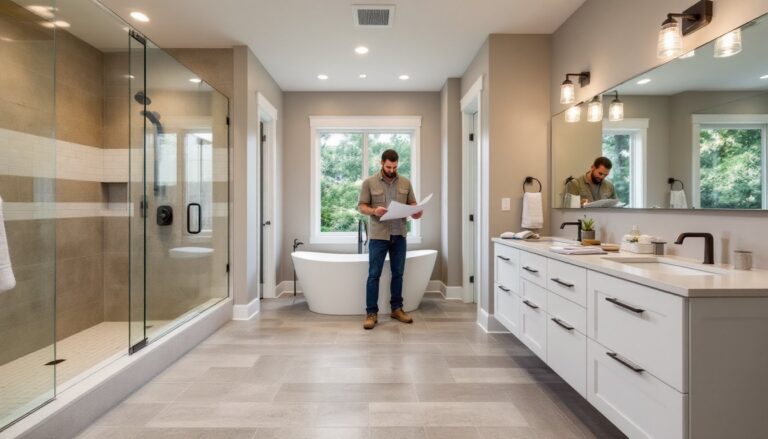
High-end bathrooms push boundaries with premium materials, custom layouts, and significant structural or mechanical work. Expect custom tile work, heated floors, luxury vanities, high-end lighting, dual sinks, walk-in showers with frameless glass, soaking tubs, and possibly heated towel racks or a steam shower.
A $30,000+ luxury renovation includes: $5,000–8,000 for custom tile or marble, $3,000–5,000 for a walk-in shower with high-end fixtures and glass enclosure, $2,500–4,000 for vanity (custom or designer-grade), $2,000–3,500 for plumbing work (potentially including rerouting, new hot-water system, or recirculation), $1,500–2,500 for electrical upgrades (outlets, heated towel racks, exhaust fans), $2,000–3,000 for lighting design and installation, and $2,000–3,000+ for contingencies and design consultation.
At this price point, you’re often working with a designer or architect. Permits, inspections, and professional-grade materials drive costs higher, but so does customization and the quality of finishes.
Key Cost Factors That Affect Your Bathroom Renovation
Bathroom size matters more than you’d think. A 5×8-foot half-bath costs far less to renovate than a 10×12-foot master bath. Larger spaces need more materials, tile, and labor hours just to cover square footage.
Structural and plumbing work is where budgets balloon. Moving a toilet, rerouting vent stacks, or adding a second sink requires licensed plumbers and costs $1,000–3,000+ depending on complexity. Structural issues, like rot, mold, or sagging subflooring, force hidden costs you won’t know about until demolition begins. Always budget 10–15% contingency for surprises.
Material grade directly impacts cost. Ceramic tile runs $3–12 per square foot installed: natural stone (marble, granite) can hit $15–30+ per square foot. A standard builder-grade vanity costs $400–800: a semi-custom or designer vanity jumps to $1,500–3,500. Faucets range from $100 (basic brass) to $800+ (luxury brands).
Local labor rates vary dramatically by region. Urban areas typically charge $55–85 per hour for skilled trades: rural areas may run $35–55. Tile setters, electricians, and plumbers are licensed in most jurisdictions, which adds to overhead and quality assurance.
Permits and inspections cost $150–500+ depending on location and scope. Structural or plumbing work almost always requires permits: cosmetic updates might not. Skipping permits saves money upfront but risks fines, insurance claim denial, or difficulty selling your home.
Ventilation upgrades, like a larger exhaust fan or installing a vent for the first time, add $300–600. Building codes now require proper moisture management, so this isn’t optional in many areas.
Research home improvement cost guides on ImproveNet to get realistic regional pricing for your area.
Materials and Labor: Where Your Money Goes
Labor typically accounts for 40–60% of total bathroom renovation costs, depending on project complexity. Simple cosmetic work leans toward the lower end: complex plumbing, electrical, and tile work pushes higher. A tile setter might charge $8–12 per square foot installed: a plumber bills hourly ($65–85) plus materials.
Fixtures and finishes (toilet, vanity, faucet, lighting, mirrors) usually run 20–30% of budget. Premium brands cost more but offer better warranties and durability. Mid-range brands like Moen, Delta, or Kohler offer solid value: budget brands often fail within 5–10 years.
Flooring and wall finishes eat 15–25% of the budget. Ceramic tile costs less than stone: vinyl plank runs cheaper than both but wears faster in moisture-heavy spaces. Waterproofing and underlayment, often invisible, are critical for longevity and shouldn’t be skipped to save $200–300.
Plumbing and electrical account for 10–20%, depending on how much rework is needed. New vent stacks, supply lines, or drain relocations multiply costs fast. Electrical work for heated floors, towel racks, or additional outlets adds up quickly.
Use a home renovation calculator to estimate materials and labor splits for your specific project scope. Professional cost estimators on HomeAdvisor can provide detailed breakdowns for your region and help you compare contractor quotes.
Smart Ways to Save on Your Bathroom Renovation
Prioritize what matters most. If you love a spa-like shower, invest there and keep the vanity simpler. If storage is your pain point, splurge on a larger custom vanity and use basic tile elsewhere. You can’t do everything on a budget, so focus your dollars where you’ll notice the difference daily.
DIY what you can safely handle. Demolition, painting, caulking, and basic fixture installation are DIY-friendly for confident homeowners. Plumbing, electrical, and tile require permits and licensed professionals in most areas, don’t skip these. Doing some prep work yourself can save $500–1,500 in labor.
Choose durable mid-range materials. Premium luxury finishes rarely justify their cost in a bathroom. A $600 vanity performs nearly as well as a $2,000 one if you care for it properly. Ceramic or porcelain tile (not natural stone) offers durability and easier maintenance at half the cost.
Avoid layout changes. Keeping plumbing in place saves thousands. Moving a toilet 10 feet or adding a second sink doubles or triples plumbing costs. Stick with the existing footprint if your budget is tight.
Bundle contractor work. Hiring one general contractor who subcontracts plumbing and electrical often costs less than hiring three separate trades and managing coordination yourself. Get detailed written quotes from at least two contractors.
Plan ahead for permits. Factor permit costs into your budget early. Some jurisdictions fast-track permits if paperwork is complete, delays cost money in labor and scheduling. A home renovation budget template helps you track all expenses and catch overages early.
Source fixtures directly. Buying fixtures wholesale or from online retailers can save 15–30% versus contractor markups. Just verify return policies and ensure they’re compatible with your plumbing.
Platforms like Angi let you compare contractor reviews and pricing, helping you avoid the cheapest bidder who cuts corners on waterproofing or finish quality.